Machine Learning for Crypto Trading Signals: Predicting Market Movements with AI
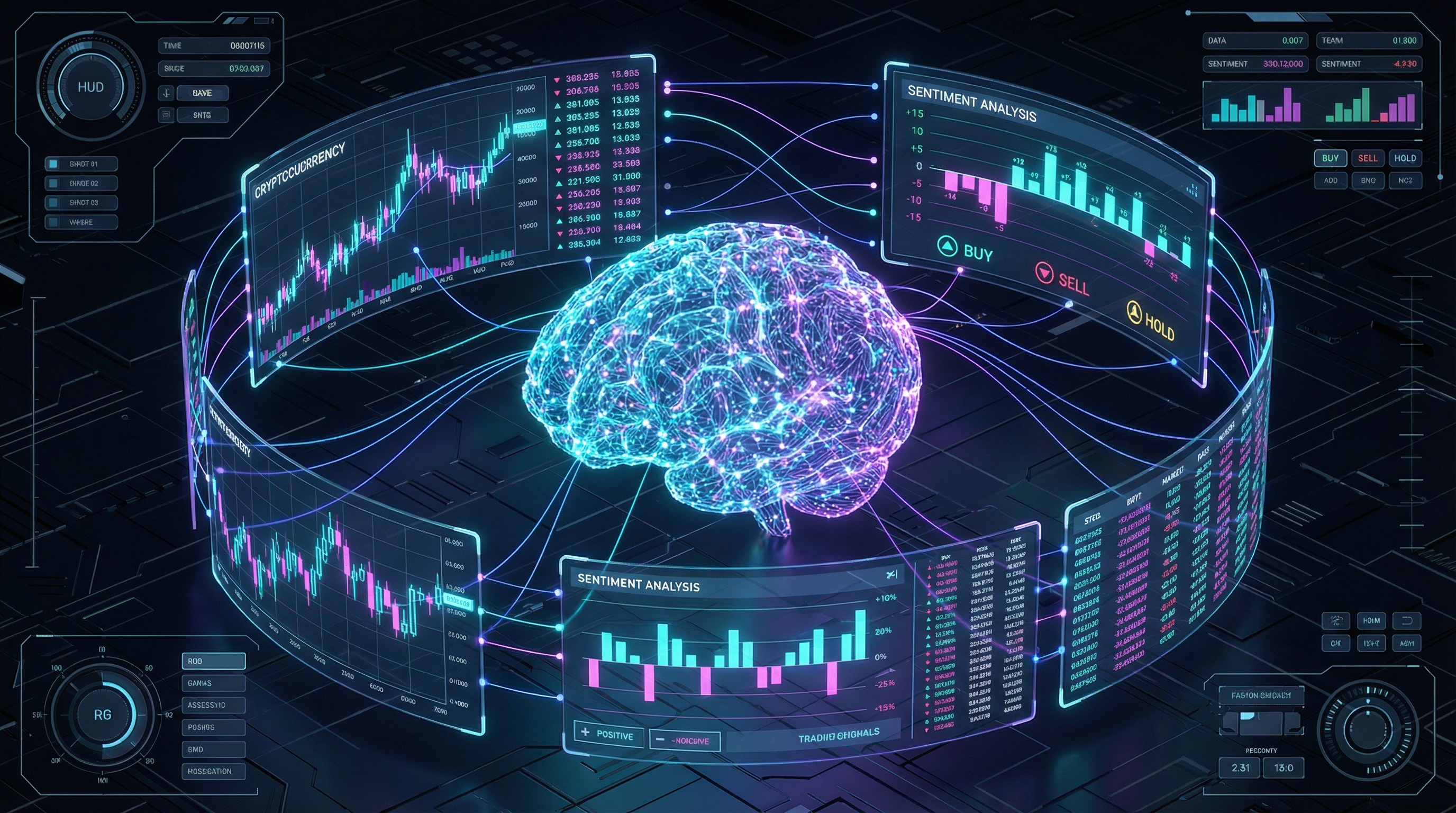
Machine learning has revolutionized how traders analyze cryptocurrency markets and generate trading signals. By processing vast amounts of data and identifying complex patterns, ML algorithms can predict price movements with remarkable accuracy. This guide explores how machine learning powers modern crypto trading signals.
Understanding Machine Learning in Crypto Trading
Machine learning is a subset of artificial intelligence that enables computers to learn from data without explicit programming. In cryptocurrency trading, ML algorithms analyze historical price data, trading volumes, social sentiment, and countless other variables to identify patterns that indicate future price movements.
Unlike traditional technical analysis that relies on predefined indicators, machine learning models discover patterns autonomously and continuously improve their predictions as they process more data.
Types of Machine Learning Models for Trading
Supervised Learning
Supervised learning models are trained on historical data where outcomes are known. For example, training a model on past price movements labeled as "bullish" or "bearish" enables it to classify future market conditions. Common supervised learning algorithms include:
- Random Forests: Ensemble models that combine multiple decision trees to predict price direction
- Support Vector Machines (SVM): Classification algorithms that find optimal boundaries between bullish and bearish market conditions
- Gradient Boosting: Sequential models that correct errors from previous predictions to improve accuracy
Deep Learning Neural Networks
Neural networks mimic the human brain's structure with interconnected layers of nodes that process information. Deep learning models excel at identifying complex, non-linear patterns in cryptocurrency markets:
- LSTM (Long Short-Term Memory): Recurrent neural networks that remember long-term dependencies in time-series data, ideal for predicting price trends
- CNN (Convolutional Neural Networks): Originally designed for image recognition, CNNs can analyze candlestick chart patterns to identify trading opportunities
- Transformer Models: Attention-based architectures that process multiple data streams simultaneously to generate comprehensive market insights
Reinforcement Learning
Reinforcement learning agents learn optimal trading strategies through trial and error. The algorithm receives rewards for profitable trades and penalties for losses, gradually discovering strategies that maximize returns. This approach is particularly effective for developing adaptive trading bots that improve over time.
Data Sources for ML Trading Models
Price and Volume Data
Historical price movements, trading volumes, and order book data form the foundation of most ML trading models. High-frequency data enables models to detect short-term patterns and microstructure signals.
On-Chain Metrics
Blockchain data provides unique insights unavailable in traditional markets. ML models analyze metrics like active addresses, transaction volumes, exchange inflows/outflows, and whale movements to predict price trends.
Sentiment Analysis
Natural language processing (NLP) algorithms analyze social media posts, news articles, and forum discussions to gauge market sentiment. Sentiment scores are fed into ML models to enhance prediction accuracy.
Technical Indicators
Traditional indicators like RSI, MACD, and Bollinger Bands serve as input features for ML models. The algorithms learn which indicator combinations are most predictive in different market conditions.
Macroeconomic Data
Interest rates, inflation data, stock market performance, and other macroeconomic factors influence cryptocurrency prices. ML models incorporate these variables to capture broader market dynamics.
How ML Generates Trading Signals
Step 1: Data Collection and Preprocessing
The ML system continuously collects data from multiple sources and preprocesses it by handling missing values, normalizing scales, and engineering relevant features. Feature engineering transforms raw data into meaningful inputs that improve model performance.
Step 2: Model Training
The algorithm trains on historical data, adjusting internal parameters to minimize prediction errors. Training involves splitting data into training, validation, and test sets to prevent overfitting and ensure the model generalizes well to unseen data.
Step 3: Signal Generation
Once trained, the model analyzes current market conditions and generates trading signals. Signals typically include:
- Direction: Buy, sell, or hold recommendation
- Confidence Score: Probability or strength of the prediction
- Price Targets: Expected price levels for entry and exit
- Risk Assessment: Volatility and potential drawdown estimates
Step 4: Continuous Learning
ML models continuously update as new data becomes available. Online learning algorithms adapt to changing market conditions, ensuring signals remain relevant and accurate over time.
Advantages of ML Trading Signals
Pattern Recognition at Scale
ML algorithms can identify patterns across millions of data points that would be impossible for humans to detect. They discover subtle correlations and complex relationships that traditional analysis misses.
Adaptive to Market Conditions
Unlike static trading rules, ML models adapt to evolving market dynamics. They recognize when market regimes change and adjust their strategies accordingly.
Emotion-Free Analysis
ML algorithms make decisions based purely on data, eliminating emotional biases like fear and greed that often lead to poor trading decisions.
Multi-Dimensional Analysis
ML models simultaneously process hundreds of variables from diverse data sources, providing comprehensive market analysis that considers far more factors than human traders can track.
Implementing ML Trading Signals
Backtesting
Before deploying ML signals in live trading, rigorous backtesting against historical data is essential. Backtesting reveals how the model would have performed in past market conditions and helps identify potential weaknesses.
Risk Management
Even accurate ML signals require proper risk management. Implement position sizing rules, stop-losses, and portfolio diversification to protect capital during inevitable losing trades.
Signal Combination
Combining signals from multiple ML models often improves performance. Ensemble methods aggregate predictions from different algorithms to generate more robust trading signals.
Continuous Monitoring
Monitor ML model performance in real-time and retrain periodically as market conditions evolve. Set up alerts for significant performance degradation that may indicate the model needs updating.
Challenges and Limitations
Overfitting
ML models can become too specialized to historical data and fail to generalize to new market conditions. Proper validation techniques and regularization methods help prevent overfitting.
Data Quality
ML models are only as good as their training data. Poor quality data with errors or biases leads to unreliable signals. Ensure data sources are accurate and comprehensive.
Black Swan Events
ML models trained on historical data may fail to predict unprecedented events like regulatory changes, exchange hacks, or global economic crises. Maintain manual oversight and risk controls.
Computational Requirements
Training sophisticated ML models requires significant computational resources. Cloud computing platforms and specialized hardware like GPUs make ML trading more accessible.
The Future of ML Trading Signals
Machine learning for crypto trading continues to advance rapidly. Emerging developments include:
- Explainable AI: Models that provide transparent reasoning for their predictions
- Quantum Machine Learning: Quantum computers enabling exponentially faster training and more complex models
- Federated Learning: Collaborative model training across multiple traders while preserving privacy
- Multimodal Learning: Models that process text, images, audio, and numerical data simultaneously for comprehensive analysis
Conclusion
Machine learning has transformed cryptocurrency trading by enabling data-driven signal generation that adapts to market conditions and identifies patterns beyond human capability. From neural networks to reinforcement learning, ML algorithms provide traders with powerful tools for predicting price movements and executing profitable strategies.
While ML trading signals offer significant advantages, they require proper implementation, risk management, and continuous monitoring. By combining machine learning with sound trading principles, traders can gain a competitive edge in the dynamic cryptocurrency markets.
Access ML-Powered Trading Signals
Experience advanced machine learning algorithms generating real-time trading signals on Aivora's platform.
Explore ML Trading